Archive

Author Archives: Milt


Our strategy includes designing a washer and dryer that does not require the user’s action to proceed from washing to drying, design a product that saves time, energy and recycles water. Among our goals is stressing the importance of sustainability and convincing a manufacturer that this product is going to be marketable and fill a significant portion of demand. By clearly illustrating these characteristics our main goal would be to persuade a company representative that our product would be a successful commercial item that would be worth manufacturing.

For achieving that goal we must design a clever, simple and recognizable logo that conveys the ideas mentioned above: ease of use, economy, environmental sensitivity, and of course less time spent doing laundry. Our website layout should be simple, clean, easy and pleasurable to navigate. It will have to display in detail our product’s technical characteristics. We will use HTML, CSS, photography, animation, and copy to clearly illustrate the product’s advantages and specifications.

The user should be able to understand with clarity why our washing/drying machine is better than a simple washer/dryer combo and why it would be profitable to mass produce it.  A manufacturer representative should be able to navigate and see the different parts of the product, each subsystem separately and everything put together, using an intuitive and efficient interface.

Final Project Time Frame and Deadlines

  • 4/3-10:  Brainstorming, ideas, sketches
  • 4/10-14:  Work on the first 2 ideas, Interactive Book & Causality. Result: Interactive Book. Start writing prose. Establish scope, strategy.
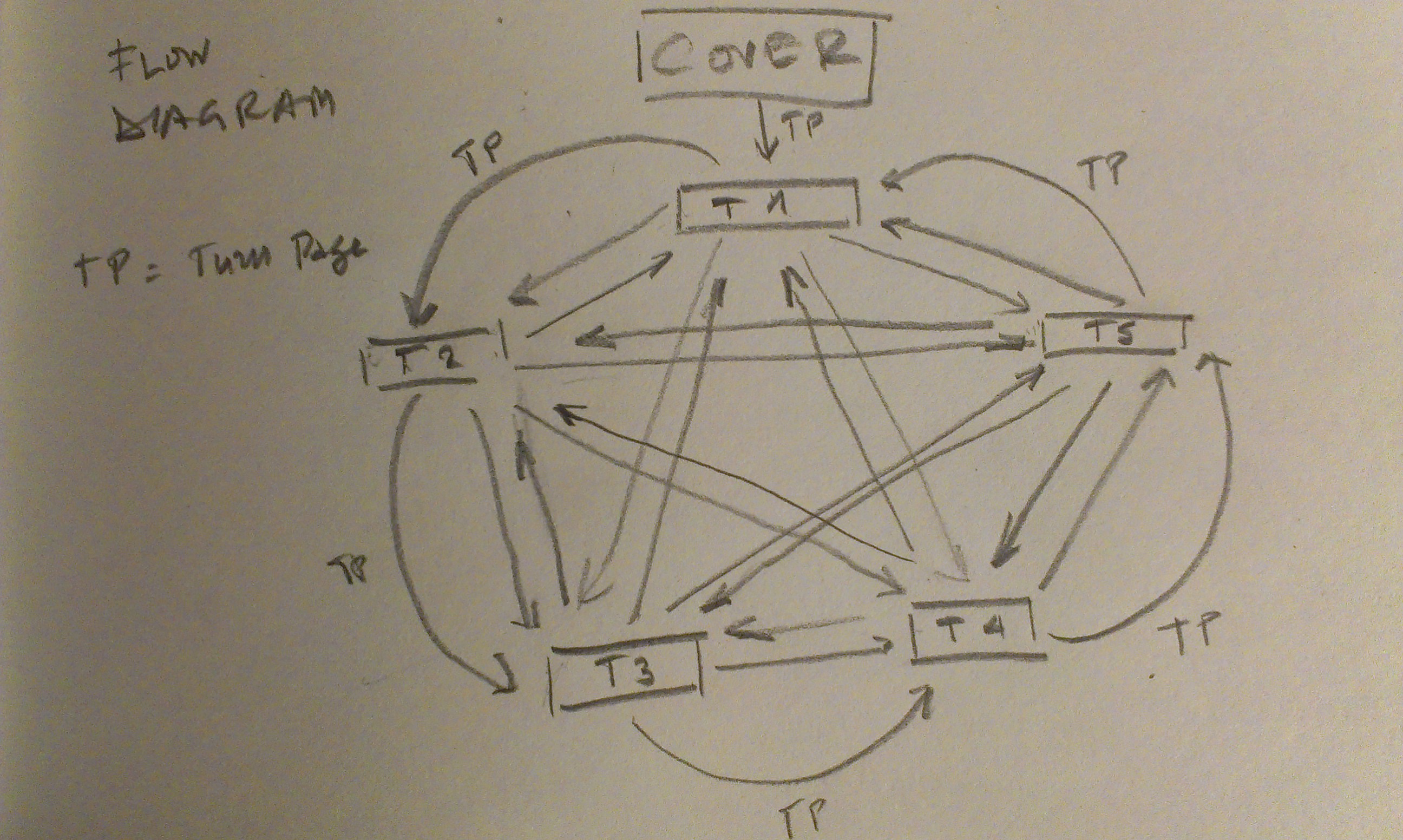
  • 4/11-17:  By the end of the day have flow diagram. Start designing the book in InDesign and Flash while working on the narrative.
  • 4/20:  Finish the prose. Work on interactivity and controls.
  • 4/21 Debug, seek feedback, and work on final version.
  • 4/24 Presentation and critique.

Strategy

The idea behind Palindrome is to make an interactive book by creating a piece of experimental narrative that is non-linear. Depending on the options provided and the reader’s choices, the story changes and the book becomes a parallel narration of possible events.  Beyond the interactive form Palindrome must be still a reading that is capable of giving a good idea of how chance and choices could affect life and create different outcomes and potentially timelines, in a universe where time would be non-linear and many different timelines could coexist.

Scope

Palindrome will be designed for any electronic device that can run flash and will rely on:

  • Text and illustrations
  • Non-linear narrative
  • Interactive elements and animation created with InDesign and Adobe Flash
  • Variable content
  • Links in the text that allow the user to switch between timelines


Notes40002

  • Eveline Clouds Cause and effect Blood Spiral Flow Diagram

Flow-Diagram


AR Live Sportscaster App


Strategy

Many times going to a stadium to watch a game, especially being an occasional frequenter of sports events, I wish I had a sportscaster right next to me: one that could provide information, player background, statistics, time, and various interesting facts about the game and the teams.

Live Sportscaster App (LSA) aims to cover that need, which is providing simple information about the players and the game during a sports event, on demand. It will also be capable of recording images and giving instant replays when desired. LSA ultimately aims to make the viewing of a sports event overall, a more enjoyable and complete experience.

Scope

The app will be designed for AR devices such as Google Glass but there could also be a smartphone version. The features and functions of LSA will be:

  • Displaying player names and information.
  • Providing player game and season stats.
  • Recording video and providing instant replays, on demand.
  • Showing team stats and information.
  • Giving game stats and information.


.LSA5 LSA4 LSA3 LSA2 LSA1 Personas1 Flow-Diagram Personas

Strategy


Many times going to a stadium to watch a game, especially being an occasional frequenter of sports events, I wish I had a sportscaster right next to me: one that could provide information, player background, statistics, time, and various interesting facts about the game and the teams.


The Live Sportscaster App (LSA) aims to covering that need, which is providing simple to complex information about the players and the game during a sports event, on demand. It will also be capable of recording images and give instant replays when desired. LSA ultimately aims to making the viewing of a sports event a more enjoyable and complete experience, overall.


Scope


The app will be designed for AR devices such as Google Glass but there could also be a smartphone version. Some of the features and functions of LSA will be:


  • Displaying player names.
  • Providing player season and career stats.
  • Recording video and providing instant replays, on demand.
  • Providing team stats and season standings.
  • Giving game stats and times.
  • Calculating and displaying distances.

Personas Flow-Diagram


March 4, 2013

App Review

Designing for New Media

Milt Chatzimouratidis

A quite popular and used by a wide variety of people app is Shazam. The word was introduced in the range of the 1930’s to 1960’s by a comic series character and means extraordinary deed or transformation. A clever choice if one thinks of how music in our days is inspired or influences popular culture. The logo is made with a circle that contains a stylized figure that strongly resembles an S. Shazam brought about a small revolution when it came out. It covered a significant demand among different types of music lovers and made remembering an artist name or song title less important. In a world where the first thing people think of taking with them is their smartphone, individual memory can be replaced by collective memory or artificial intelligence. Although Shazam will never be as popular as Google Search, for example, it has become a useful daily instrument.

The app has a fairly simple interface: the starting screen is made of a four-part navigation bar on top and an oversized logo that covers the rest of the screen.  Once the music is identified, the user is taken to a screen with the album art and various resources for sharing or buying music, reading the lyrics of the song, and retrieving information about the particular piece or artist. Simplicity is the keyword here: very few steps to reach the desired information make the app functional and usable.  Again, simplicity in aesthetics reveals that the design is focused on making the app functional and usable rather than giving it an original look. Back to the starting screen, accessing the list of songs that the user has tagged, his or her friends’ comments through social media, or the chart of most tagged songs – is that really needed? – is a matter of a single tap.

Shazam is an easy process for any user: start the app, tap anywhere on the logo. One must allow a few seconds until the data file is sent and matching process is complete then get the answer. That is the main process. Then a user may choose to share the music through social media, buy the music, look up information or videos about it, check out the lyrics or the artist’s discography, or read a review, among other things. Each one of these functions is accessed through a single tap; however, some of them take the user to external sites that require more effort than that.  Shazam’s guess rate is fairly high according to various articles it ranges from 60 to 85% which means it uses appropriately accurate recognition software and also a pretty big database.

Overall, Shazam has changed people’s lives, not in a spectacular way but it has definitely contributed in searching, finding, and buying music more easily, in a simple and accessible almost to everyone way.

I would define as new media anything that conveys ideas or information and while using the new technologies (computers, tablets, smartphones, etc), displays, video, text or reproduces sound.

What are the goals of Apple’s website? How does Apple’s website address the needs of a user who has just purchased their first MacBook?

A. Apple’s website not only displays the company’s products but also lets the user have a closer look of their features and functionality, utilizing an intuitive and user-friendly interface. It helps the user understand the full potential of the device he or she just purchased and access tutorials on and off line.  The website allows commercial transactions as well.

What are the functional specifications of Facebook’s wall? If you are not on Facebook what are the specs for the signup page?

A. Not sure I fully understand the question. Facebook’s wall works as an editable news feed system that allows the use of type, images and video but also comment entries from third parties.

What are four architectural approaches to information structure? Find one example of each.

A. Hierarchical, matrix, organic, sequential. Hierarchical examples abound. Apple for one. Matrix examples: Starbuck’s, Amazon. Organic model: 3M, Ebay.  Sequential:?

What percentage of The Huffington Post index page is navigation, and what percentage is content? What about Google, Wikipedia, and Etsy?

A. Huffington Post’s index page is a bit like Netflix. Almost everything is in front of the user’s eyes from the beginning. On the other hand Google, Wikipedia, and Etsy to a lower degree, provide minimal content and heavily rely on navigation. Especially Wikipedia and Google’s main page is close to 100% navigation.

How does http://www.landor.com guide the readers’ eyes and focus their attention on what is important?

A. www.landor.com uses a complex outline, color, animation, exploits contrast in color, opacity and size to capture the user’s attention. There is a large number of links in the index page, the most important ones use vibrant colors and are larger than the others.